Eleven logins on day one
Most small businesses run on six to twelve software systems. New starters get all of them on day one. 81% feel overwhelmed.
Eamonn Best
Founder, Lattify · May 12, 2026
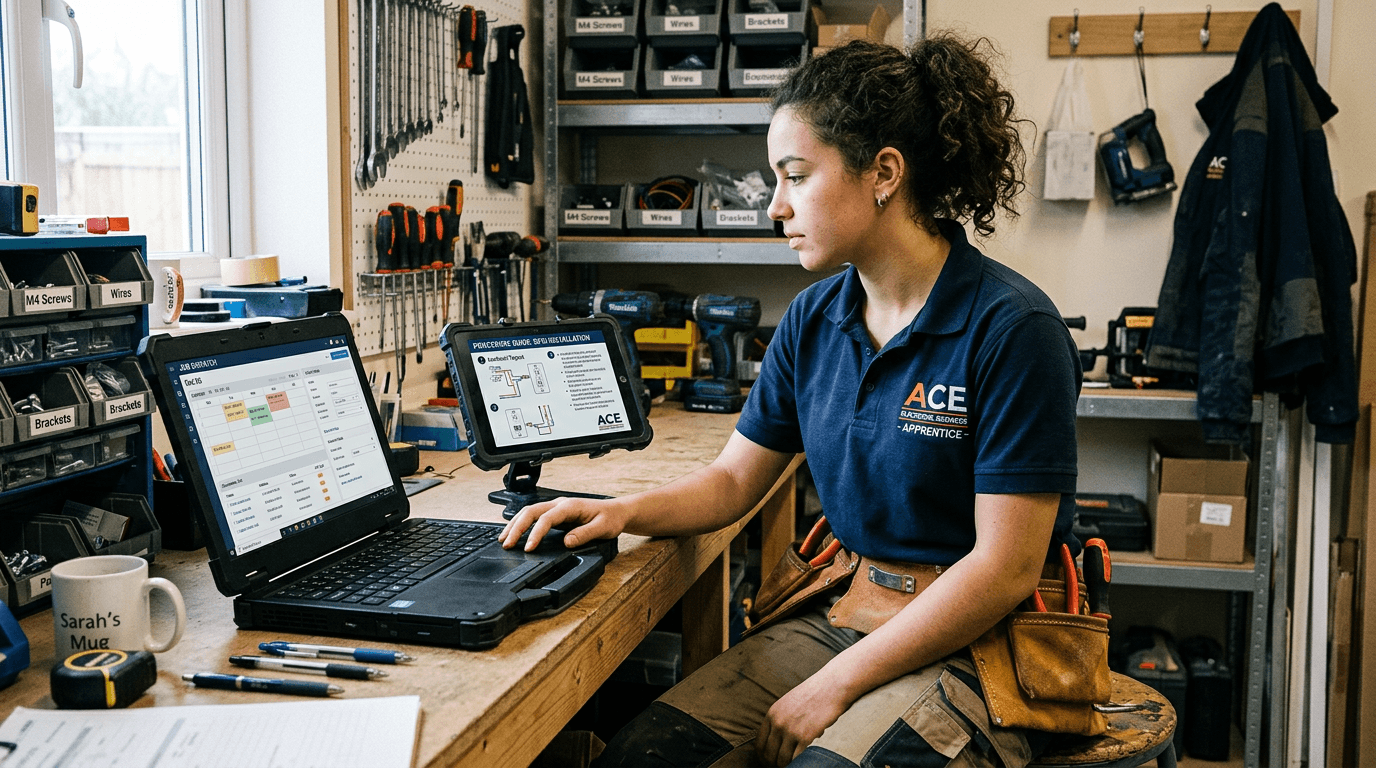
Picture a new starter's first morning at a typical small business. Before they've made anything, fitted anything, served anyone, they need logins for the POS, the rota app, the time clock, the customer database, the supplier portal, the team's messaging tool, an accountancy login, a payment processor, a compliance log, a delivery integration, and the company's own internal app. Eleven logins. They start at 9am. The actual work begins somewhere after lunch.
According to the 2026 onboarding statistics summarised by AIHR, 81% of new employees feel overwhelmed during onboarding, 78% report missing one or more tools to do their job, and 74% say their onboarding was not successful. 29% decide in their first week whether to stay.
The role itself, the actual craft, the customer-facing work, the thing the new starter was hired to do, has barely been introduced.
The modern SMB software stack
The trajectory of how many apps an organisation runs has only gone one way. According to the Zylo 2025 SaaS Management Index, the average organisation now runs 305 SaaS applications. Large organisations average 696. New applications enter the average tech estate at around 12 per month, which works out to 91 new apps a year, or 34% annual portfolio growth. One-third of those apps operate as shadow IT, deployed without IT approval and almost never with formal training.
For SMBs the headline number is lower, but the load per individual role is sharper. The UK Government's Longitudinal Small Business Survey 2024 (the latest official data available) found that 80% of SME employers used accountancy software, 62% used electronic invoicing, 57% used video-conferencing, and 57% used payroll software. Adoption rises with company size: 92% of medium-sized businesses used accountancy software, compared to 78% of micro businesses.
Those are the back-office systems. Add the customer-facing ones (the POS, the booking system, the payment terminal, the supplier portal, the compliance log, the rota app, the messaging tool the team actually uses), and the typical 12-staff SMB now runs between six and twelve software systems day-to-day.
What does this look like vertically?
A hospitality SMB runs Toast or Square (POS), 7shifts or Deputy (rotas), Stripe or SumUp (payments), Xero (invoices), Mindbody for workshops, Uber Eats and Deliveroo for delivery, a hygiene rating compliance log, a time-clock app, an H&S documentation system, the supplier portal for stock orders, and WhatsApp for shift swaps the rota system doesn't quite handle. Eleven, before email.
A trades firm runs a job dispatch tool like Jobber or ServiceTitan, Xero for accounts, Stripe for the card terminal in the van, WhatsApp for the crew chat, two or three supplier portals (Wolseley, Plumb Center, City Plumbing), a certification body portal (NICEIC, Gas Safe Register), a customer review tool (Checkatrade, Trustpilot, Google Reviews), a mileage and expense tracker, a time-on-job logger, and the customer's own portal for commercial jobs. Eleven again.
A dog daycare runs Gingr or PawsAdmin for booking, a payment processor, a vet liaison system, an incident logging app, social media tools for parent updates, a rota app, accountancy software, a supplier portal for food and supplies, a vaccination tracking system, and WhatsApp. Ten or eleven.
Same shape. Different apps. Six to twelve systems per business.
What this does to training
The traditional model of training assumed one of two things. Either the new starter learns the physical craft by watching a senior do it. Or the new starter reads a written manual that someone wrote down in advance.
The modern SMB has a third kind of knowledge. Software-procedural. How to push a job update when the customer reschedules on the morning of the appointment. How to issue a credit note when the payment came through with a partial refund. How to mark an incident in the daycare system. How to handle a booking conflict in Mindbody. How to do a Toast refund when the customer paid with a split payment and one card declined.
These workflows live on screens. They have hundreds of edge cases. They change every six months because the software vendor pushed an update. And nobody on the team was trained on them properly because nobody had time to write the training.
The Zylo 2025 report puts the licensing-waste figure at 52.7% of purchased licenses going unused, costing the average organisation around $21M annually. That waste is the financial signature of software no-one has been trained on properly. Companies buy seats nobody uses, because nobody knows how to use them, because nobody trained anyone.
Shadowing fails here too. The senior staff member cannot show the new starter how to do a Xero credit note properly because the senior has done one seven times and got it slightly wrong four of those times. There is no canonical knowledge in the building to transfer. Both of them are guessing.
This is the part of the modern SMB job that breaks the most often, that gets the least training, and where the customer is most likely to see the mistake. A wrong charge. A missed booking. A mishandled refund. A double-booked appointment.
Why every existing tool only covers one slice
The market has training tools for each kind of knowledge. The problem is each tool only covers one kind.
Screen-recording tools are built around capturing software workflows. They turn "click here, then here, then here" into a step-by-step guide. They have zero value for the physical-craft side of the business. You cannot film a flat white being made with a screen recorder, or a consumer unit being wired, or a dog being handled. The product can only see what's on a screen.
Most training apps assume the owner sits down and writes the content. The newer ones have an "AI assist" feature that helps you write faster, but the input is still text from someone's head. The owner of a 12-staff cafe or a 6-staff trades firm is unlikely to sit down and write the procedures, because if they could do that, they would have. The training stays in their head, unwritten.
YouTube is linear and unsearchable. The senior records a five-minute walkthrough. The new starter watches it on day one. Two weeks later they need to remember step 4 and have to scrub through the whole video again. They don't bother. They guess.
Short screen recordings shared in WhatsApp get buried in chat threads. The senior sends a quick walkthrough on a Tuesday. The new starter who needs it on Friday cannot find it. The owner has lost the link too.
Shadowing requires the senior to be there. The shadow only works during shifts the senior is on. The new starter on a quiet Sunday morning has no shadow to follow.
Operators end up with a fragmented toolchain. A screen-recording tool for the POS workflow. A half-finished training-app page for the safety procedures. A YouTube video for the brine. A quick walkthrough in WhatsApp for the credit note. The compliance manual as a PDF nobody opens. The content is scattered across five tools, and none of it is searchable as one library. The staff member who needs an answer on Saturday at 7pm doesn't know which tool to open and doesn't bother.
What I built to fix this
That's why I built Lattify to take every input format and produce the same structured output. One primitive, every kind of knowledge.
Phone video for the physical work. The senior films the brine being made, the dough being shaped, the radiator being bled, the dog being handled. The AI watches the video and extracts the steps, timings, equipment, and safety notes.
Screen recording for the digital workflows. The senior records herself doing a Toast refund or a Jobber reschedule. Silent recording works (the AI uses Google Vision to read the button labels, menu items, and screen states) or narrated recording works (Whisper transcribes the audio and matches it to the visible UI). Output is the same step-by-step guide as the physical-world capture, with screenshots embedded at each step.
PDF, Word doc, or existing manual. The 12-page allergen handling document the supplier sent through gets parsed into searchable steps. Assigned to staff. Comprehension tracked. The fire safety document, the food hygiene policy, the certification regulations, all become live structured guides instead of dead PDFs in a folder.
Audio note. The senior records a three-minute audio walkthrough on her phone while walking from prep to pass, describing the morning routine. The AI transcribes it and structures it into ordered steps. No filming required.
Photo. Snap a page of a paper procedure. OCR pulls the text. AI structures it. The handwritten note pinned to the wall behind the till becomes a searchable guide.
Five input surfaces. One structured output. Every kind of knowledge that runs a modern SMB, on every staff phone, in the language they speak.
Why this matters for SMB specifically
Enterprise solves the multi-format problem by hiring separate L&D specialists per system. One tool runs the LMS. Another runs in-app POS guidance. A third authors the compliance modules. Each tool is its own contract, its own login, its own ongoing cost.
For a 12-staff cafe or a 6-staff trades firm, that stack is impossible. The cost of L&D per system is too high. Most SMBs end up with no formal training tool at all and accept that staff will figure out the eleven apps as they go.
Lattify covers every format at one SMB price. Phone video, screen recording, PDF, audio, photo. Same primitive, same delivery layer, same search.
The new starter on Monday has eleven logins waiting. According to the 2026 onboarding data, 81% of new starters feel overwhelmed on day one and 78% say they're missing tools they need to do the job. The training stack has to cover both the craft and the software, or the new starter gets one and misses the other.
If any of this sounded familiar, we built Lattify for exactly this problem.
Join the Waitlist