Don't Write It, Film It
Everyone has a 4K camera in their pocket. The training manual was a workaround. The workaround is over.
Eamonn Best
Founder, Lattify · March 26, 2026
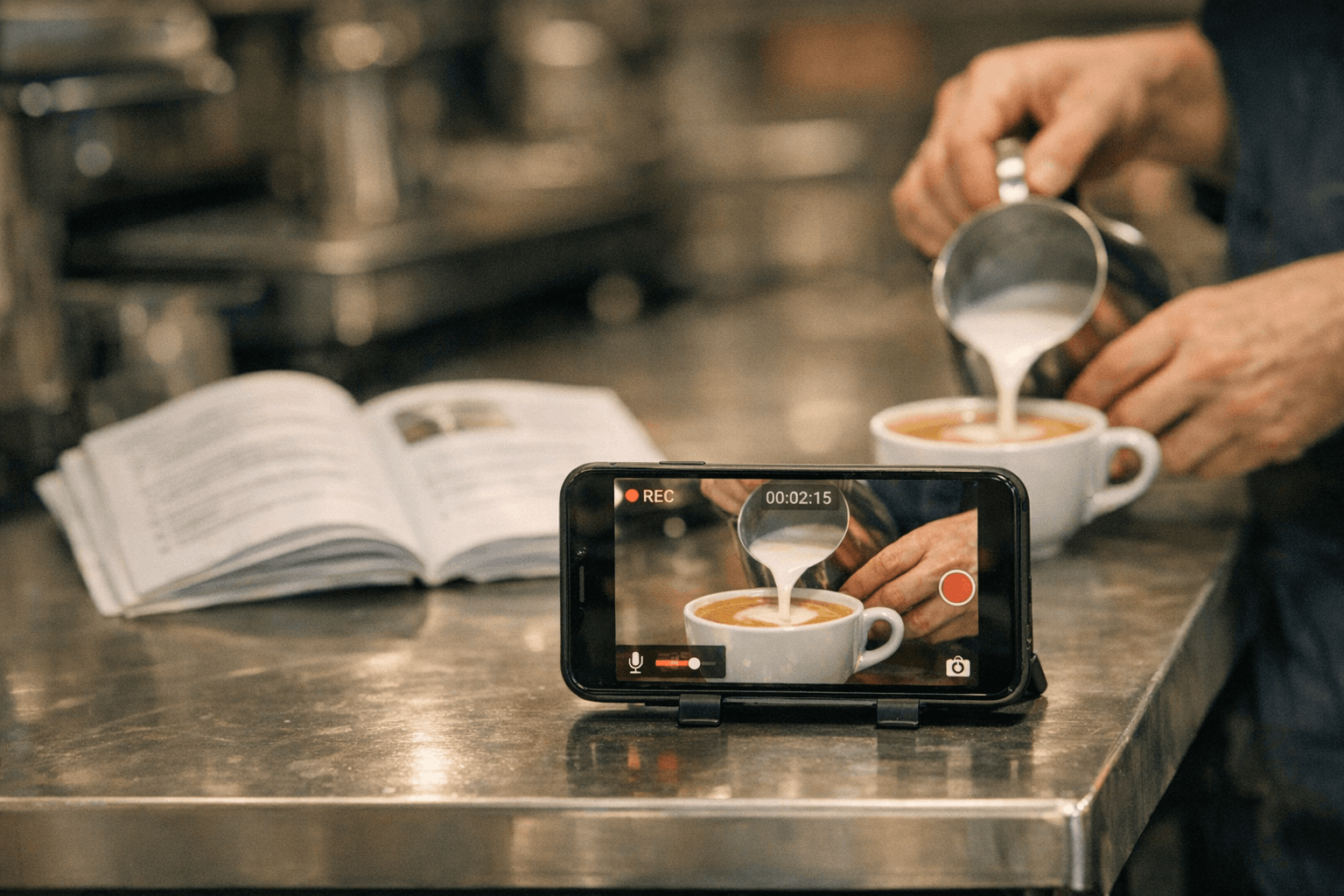
I found a barista training manual online the other day. Ten pages. Someone had clearly spent hours on it - milk temperatures, grind sizes, how to hold the jug for a flat white. Detailed stuff. Genuinely well written. The last line on the final page was: "Questions? Call the owner."
Ten pages of instructions, and the fallback for anything that didn't land was a phone call. Which tells you everything about what the person who wrote it already knew deep down - that someone was going to read all of that, get to the espresso machine on their first shift, and still have no idea what they were doing.
Why we ended up with manuals in the first place
Training manuals exist because video used to be hard. Before 2010, if you wanted to produce a training video for your venue, you were looking at a camera crew, editing software, and some way to actually distribute the finished product to your staff. You'd burn it to a DVD, maybe. Or host it on a shared drive nobody could find. The cost and effort were completely disproportionate to "here's how we close on a Tuesday."
So the manual became the default. You could type it up in Word, print a few copies, stick one in the break room. It was the practical option given what was available, and for decades it was the only option that didn't require a production budget. The manual was always the workaround.
The problem with reading your way through a physical task
Here's what the research actually says about learning physical tasks from text versus watching someone do them.
Richard Mayer, a psychology professor at UC Santa Barbara, has spent decades studying how people learn from different media. His core finding is that people learn significantly better from words combined with visuals than from words alone. Across eleven experimental comparisons carried out in Mayer's lab, students performed better on transfer tests when illustrations or animations were added to verbal descriptions, yielding a median effect size of d = 1.39 (Mayer, 2009). In plain terms, that's a very large effect - well above the d = 0.8 threshold that researchers classify as "large." Adding visuals to words produces one of the strongest measured improvements in learning outcomes of any instructional technique Mayer has tested.
A 2022 systematic review published in the International Journal of Environmental Research and Public Health looked specifically at observational learning for motor skills - watching someone perform a physical task. The review covered eighteen studies and found strong evidence that people who watch a demonstration learn physical skills more effectively than those who don't. That finding held across different skill types, different ages, and different settings. When the task is physical, watching beats reading.
And it makes intuitive sense when you think about hospitality work. Almost everything your staff do is physical. Pouring a beer, changing a keg, plating a dish, closing the till, setting a table, cleaning the grease trap. These are hands-and-eyes tasks. Describing them in text means converting a physical process into words, and then asking the reader to convert those words back into physical movements in their head. Every step of that translation is a place where information gets lost.
And then there's the engagement question. Anyone who has managed a team knows that a ten-page manual sitting in a break room folder gets skimmed at best. A short video on someone's phone gets watched. When you need to learn how something is physically done, watching someone do it is the format that matches the task. Reading ten pages about milk texture is a workaround for what could have been a ninety-second video of someone actually steaming milk.
The time it takes to write one
Let's talk about the practical side. You run a venue. You work sixty-hour weeks. When exactly are you sitting down to write a training manual?
Research from the Chapman Alliance, published through the Association for Talent Development, found that professional training developers average 67 hours of development time to produce one hour of classroom instructor-led training material. Sixty-seven hours. Now, a venue owner typing up a close procedure in Word is obviously a simpler task than what those instructional designers are building. But even writing up a basic set of docs - your close, your open, your prep checklist, your allergen procedures, your till close, your cellar management - takes hours of evenings you don't have.
The same ATD research found that 67% of training teams say limited resources - time, budget, headcount - is their top barrier to creating training faster. And 37% say the biggest bottleneck is getting the subject matter expert to sit down and document what they know. In a restaurant, the subject matter expert is your head chef, your best bartender, your senior floor manager. They're cooking 200 covers a night, not sitting down to write documentation.
Now think about filming a walkthrough on your phone. Your best closer walks through the close while recording on their phone. Three minutes, maybe four. They show the till, the float, the alarm, the lights, the locks. Done. The whole thing took less time than writing the introduction to a manual would have. And the new starter watching it back will understand it faster, because they can see the till, the alarm panel, and the layout of your actual venue rather than reading a description of where things are.
The time difference between writing a proper manual and filming a proper walkthrough is hours versus minutes. For someone working sixty-hour weeks and running a business on thin margins, that gap is the difference between "I'll get to it eventually" and "it's done."
What happens to the manual you actually write
But let's say you do find the time. You sit down on a Sunday night and write the whole thing out - the open, the close, the prep list, the allergen folder. Hours of work. What happens next?
First question: where does it live? In a binder behind the bar that gets buried under menus and order pads within a week. On a shared drive that half your team doesn't have access to because nobody set up their login. As a PDF on the manager's laptop, which is either at home, in their bag, or dead. The document exists. Getting to it when you actually need it - at 11pm on a Friday when the new closer can't find the alarm code - is a different problem entirely.
Second question, and be honest with yourself here: does anyone actually read it? You might get a new starter to flick through it on their first day while they're waiting for their uniform. They'll skim the headings, read the first line of each section, and put it down. A ten-page document about procedures they haven't encountered yet is abstract. It means nothing until they're standing in front of the espresso machine or staring at the till screen, and by that point the manual is back in the break room and they're on the floor.
Then the process changes. You switch POS systems, or the brewery changes the keg couplers, or you move the prep station to the other side of the kitchen. The manual is now wrong. And nobody updates it, because updating a manual is the same time problem that made it hard to write in the first place. Within weeks, you've got a document that's confidently telling new starters to do things the old way. That's worse than having nothing, because now someone's following instructions that are actively incorrect.
There's no accountability either. You can't tell who's read it. You can't tell who got halfway through and gave up. You can't tell which sections are confusing people, because there's no way to see where someone paused, re-read, or skipped ahead. If three people in a row get the cellar changeover wrong, you have no way of knowing whether they all struggled with the same paragraph or whether none of them opened the document at all.
And what about the staff member whose first language isn't English? A written manual full of idioms and jargon - "run the taps through," "strip the machine," "float the till" - is close to useless for someone who's still learning the language. They'll nod, they'll say they understand, and they'll guess when they get to the floor. Three weeks later they're gone and everyone decides they weren't up to it, when the manual was the thing that let them down.
There's one more failure mode that nobody thinks about until it happens. The person who wrote the manual leaves. Maybe they move on, maybe they get promoted, maybe they just stop working Sundays. Now you have a document that nobody fully understands, because the context and reasoning behind half of it walked out the door with the person who wrote it. Nobody's confident enough to update it, so it sits there gathering dust, technically available and practically dead.
You put hours into writing something useful, and within a month it's a static document that nobody reads, nobody updates, nobody can track, and nobody can maintain. All that effort, and the thing is dead before the next rota goes up.
The phone in your pocket
Every small business owner in the country is carrying a 4K camera right now. The device you're reading this on can shoot video that's sharper than what a professional crew would have produced fifteen years ago. The production barrier that made manuals necessary - the cameras, the editing, the distribution - is gone. It's been gone for years. But the habit of reaching for a Word document has outlasted the reason for it.
The barista manual I found online was uploaded in 2023. Someone sat down and typed out ten pages of instructions for a physical task - making coffee - when they could have propped their phone against the machine and filmed the whole thing in the time it took to write the first page. The manual was a workaround for a problem that doesn't exist anymore.
Where the video goes
The filming is the easy part. The harder question has always been: what happens after you film it? A raw phone video sitting in someone's camera roll or buried in a WhatsApp thread is marginally better than a manual, but it still has the same basic problem. When your new starter needs to remember step six of the close at 11pm on a Wednesday, they're scrubbing through a four-minute video trying to find the right moment. That's a lucky dip.
This is the problem I built Lattify to solve. A three-minute recording of your close procedure goes in, and Lattify's AI breaks it apart into individual steps - each one its own thing, each one jumpable, each one clear. The new starter taps the step they need. The knowledge that lived in your best closer's head is now structured, accessible, and on every new hire's phone before their first shift. When the procedure changes, the guide updates with it. One recording captures it. The AI structures it. Your team uses it.
The workaround is over
That barista manual was somebody's best effort with the tools they had. I don't fault them for writing it. But the tools have changed, and the evidence on how people actually learn physical tasks hasn't been ambiguous for a long time. Watching beats reading, filming beats writing, and the camera is already in your pocket.
If any of this sounded familiar, we built Lattify for exactly this problem.
Join the Waitlist