The Quiz Asked Me About Hotel Beds. I Wash Pots.
Most hospitality 'training' is a compliance checkbox disguised as preparation. Your staff know it. Here's what they say.
Eamonn Best
Founder, Lattify · March 20, 2026
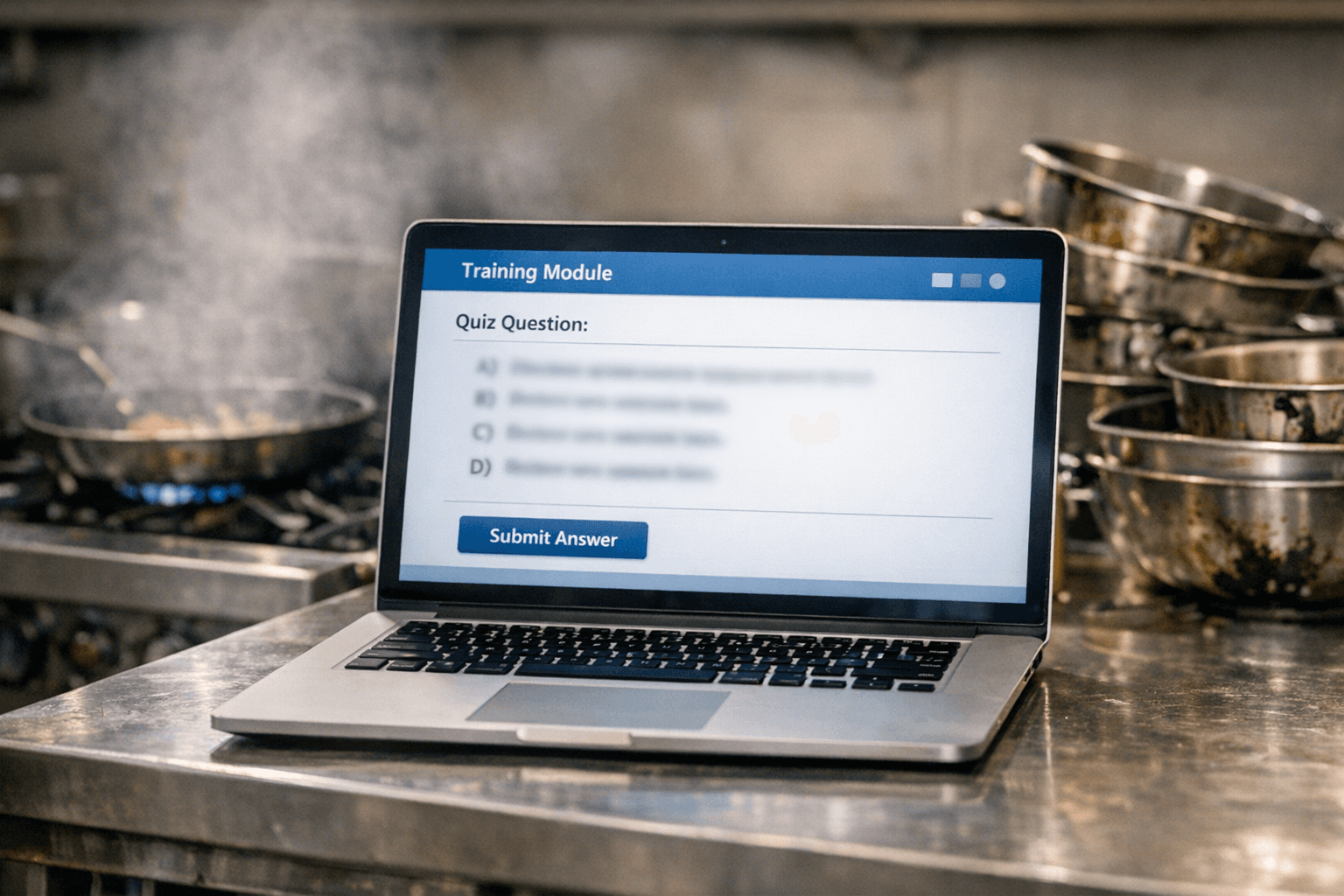
A kitchen worker at a national pub chain wrote a long review on Glassdoor about the training he got when he started. He washes pots. That's the gig. The only training anyone gave him was online - quizzes, modules, the usual. Some of the quizzes ran to forty questions, and if you got a single answer wrong you had to restart the whole thing from the beginning.
Two shifts in, the quiz started asking him about the correct way to change beds in the company's hotels.
He washes pots in a pub kitchen, and the training system wanted him to demonstrate his knowledge of hotel bed-change procedures. He'd never been to one of the chain's hotels. He'd barely been to the pub kitchen twice. But the system needed its forty answers, so there he sat, clicking through questions about bed linen for the third time because he got question 27 wrong.
Meanwhile, out on the actual floor, nobody had told him where anything was. The walk-in fridge was full of plain brown boxes with no labels, things moved around constantly, and at ten hours a week there was no way to keep track. People got annoyed when he took too long to find things. The experienced staff all had their own shortcuts and bad habits, and when he copied what they did - because why wouldn't you assume the person who's been there a year is doing it right - he got told off for doing it wrong.
The quiz didn't cover any of that. The fridge, the labelling, the shortcuts, the close - all of it was supposed to be picked up on the job by someone working ten hours a week who'd completed his modules and still couldn't find the chopping boards.
Where the quiz came from
There's a version of online training that makes sense. Food safety certification, allergen awareness, health and safety basics - these are legal requirements, and having a system that tracks completion is genuinely useful. If Environmental Health show up and want to see that your team completed their food hygiene training, you need that paper trail. Fair enough.
But somewhere along the way, the compliance system - designed to prove your staff had ticked the legal boxes - became the entire training programme. The business can point to a dashboard showing 94% module completion. The auditor sees a paper trail. And everyone treats this as evidence that staff have been trained, when all it actually proves is that they answered enough multiple-choice questions correctly to generate a green tick.
A food safety quiz will teach someone that raw chicken should be stored below cooked food. It will not teach them which shelf in your specific walk-in has the chicken, how your kitchen labels its prep, what your close procedure looks like, or what happens when the glass washer backs up at 9pm on a Friday. One protects the company legally. The other is the reason your new starter survives their first week.
"Pointless and lazy"
The pot washer's review is the most detailed I've come across, but the frustration runs through dozens of others. I've been reading employee reviews at major UK hospitality chains for weeks now, and online training comes up constantly - described the same way every time, always as the thing the company points to when it says "we train our staff," and always as the thing the staff themselves say taught them nothing about the actual job.
A kitchen porter at the same pub chain, based in Leeds: "Online training is pointless and lazy."
A cleaner at the same chain, in Cardiff: "No formal training just online and they expect miracles."
Floor staff at another branch: "Online training was expected to be done in own time." Do it at home, on your phone, unpaid, and then turn up ready to perform a job nobody has actually shown you how to do.
Bar staff at the same chain described their entire onboarding in one sentence: "Very little training given - watched a 30 min catering video and was shown how to 'pull a pint.'" A video and a pint. Off you go.
A team member at a national bakery chain: "Poor training - relied too much on 'online learning' and made very little effort to train you properly."
And then there's a general manager - not a new starter, a GM - at a national Italian chain who said simply: "Company training is lacking and all online." When the general manager is describing the same problem as the pot washer, the system itself is broken.
What quizzes can't do
The gap between what online training covers and what the job actually requires is where every failure in this data sits. The pot washer can answer questions about hotel beds but can't find the chopping boards. The kitchen porter has completed every module and still has to learn the actual job by asking around. The bar staff watched a thirty-minute video and pulled a practice pint, and that was supposed to be enough.
There's a reason the format falls short for this kind of knowledge. Dr John Medina's research on visual learning, documented in Brain Rules, found that people retain around 65% of information presented visually after three days, compared with roughly 10% of what they read or hear. The person on the fryer doesn't need a multiple-choice question about oil temperature ranges - they need to see how your specific fryer works, in your kitchen, with your oil schedule. The pot washer doesn't need a quiz about hotel beds. He needs to see someone walk through the fridge once so he knows where things are without having to ask five times while people glare at him.
Online training platforms are built around text and multiple choice because those formats are easy to automate and easy to score. You can pull a report. You can show a percentage. You can demonstrate to someone who never works a shift that training is happening. But the report measures whether someone can pick the right answer on a screen, and the job requires them to find the cling film in a dark kitchen at speed. Those are different skills, and no amount of quiz design will close that gap.
The knowledge already exists
The knowledge the pot washer needed - where everything is in the fridge, how the kitchen runs, what the close actually looks like - already existed. Someone in that kitchen knew all of it. Probably several people. The problem was that nobody had written it down, filmed it, or structured it in any way that a new person could access without physically standing next to someone and hoping they had time to explain.
Online training platforms were built to deliver standardised content at scale - the same allergen module for every branch, the same food safety quiz for every role, the same bed-change questions for pot washers and hotel staff alike. The specific, practical, venue-level knowledge that actually makes the difference on someone's first shift was never part of the system.
I built Lattify because I kept seeing this same gap - the knowledge exists in the building, but nobody has captured it in a way the new person can actually use. Someone on your team records the walk-in layout, the close, the fryer schedule - whatever it is - on their phone, and Lattify turns that recording into a step-by-step guide the new starter follows on their own device. Each step is its own thing, so they can jump to what they need mid-shift without scrubbing through a long video or restarting a forty-question quiz. When something changes, the guide updates with it.
And because it's visual and filmed in your actual venue, the new kitchen porter can work through it at his own pace, in any language, and walk in already knowing where the chopping boards are.
What the green tick actually means
That pot washer's training dashboard almost certainly showed him as fully trained. Green tick. Module complete. Compliant. The system did exactly what it was designed to do - he answered enough questions correctly, the database updated, and everyone from his manager upwards could see that training had been delivered.
Then he walked onto the floor, couldn't find anything in the fridge, got glared at for being slow, copied the experienced staff's shortcuts, got lectured for doing it wrong, and went home to restart a quiz about hotel beds. And the walk-in fridge didn't care what his pass mark was.
All employee quotes in this article are drawn from public reviews on Indeed and Glassdoor for major UK hospitality chains, collected between 2024 and 2026. Chains have been anonymised.
If any of this sounded familiar, we built Lattify for exactly this problem.
Join the Waitlist