You Built the Manual. Nobody Opens It After Week One.
Training content has a shelf life of about a week. After that, your staff need something that works mid-shift.
Eamonn Best
Founder, Lattify · April 13, 2026
You spent a Sunday afternoon filming the close. Or you typed up the SOPs and got them laminated. Or you paid for a training platform and loaded it up with everything your team needs to know - the open, the close, the prep list, the allergen folder, the lot. Your new starter went through it all in their first week, ticked the boxes, watched the videos, and you felt like you'd finally built something that would stop you answering the same questions over and over again.
By Friday they'd stopped opening it. By week three it might as well not exist. And there you are, at 11pm on a Tuesday, explaining the till void process to someone who definitely completed that module eighteen days ago.
The frustrating part is that you did everything right. The content is good. The information is there. The problem is that the tool was built for a moment that already passed.
The shelf life of training content
Training material has a natural arc. In the first few days of a new job, people are in learning mode - they're absorbing how things work, getting their bearings, building a mental map of the business. During that window, a structured onboarding guide is exactly what they need. They'll sit through it, they'll pay attention, and they'll retain a decent amount of it.
That window closes fast. Hermann Ebbinghaus's research on memory decay - replicated and confirmed in a 2015 study published in PLOS ONE by Murre and Dros - showed that the ability to recall new information drops sharply within hours of learning it and continues to decline over the following days and weeks. The steepest part of the curve happens in the first day. By the end of the first week, what someone learned on Monday has already faded significantly unless they've had reason to use it.
In a frontline business, that reason doesn't arrive on a schedule. Your new closer might not encounter the till void until shift four. The gas isolation procedure might not come up until week three. The bain-marie temperature for Sunday carvery service might not matter until their first Sunday, which could be three weeks into the job. By then, the onboarding module that covered it is a distant memory, and the training platform is something they associate with their first day, along with filling in the tax form and being shown where the bins go.
The question changes shape
There's a distinction that matters here, and once you see it you can't unsee it. In week one, your new starter asks learning questions. How does the close work? What's the flow for morning prep? Where does everything go in the walk-in? These are broad, conceptual questions, and a training guide handles them well. You need the full picture, so you sit with the full guide.
After week one, almost every question is a retrieval question. Which button resets the till after a void? What temperature does the bain-marie need to be at for service? Where's the stopcock in this building? Which colour keg line is the lager? These questions are specific, urgent, and come up mid-shift when someone is standing in front of the thing they need to operate. The person asking already knows how the close works in general. They need one piece of information from inside the process, and they need it in the next thirty seconds.
A training guide is built for learning questions. It assumes you're going to sit down, work through the material, and absorb the whole thing. When someone has a retrieval question at 11pm, a seven-page PDF or a four-minute video walkthrough is useless to them. They need step six. And the training tool has no way to give them just step six, because it was designed for a beginning-to-end experience that ended two weeks ago.
The manager becomes the system
When the training material stops being useful for retrieval, the knowledge has to come from somewhere. In most frontline businesses, that somewhere is a person - usually the manager, or whoever happens to be the most experienced person on shift.
ATD research published in January 2025 found that 75% of organisations use on-the-job coaching by managers as their primary method for training frontline employees. That stat is usually read as a commentary on the state of training technology, but it's worth reading it differently. It means that in three out of four organisations, the manager is the knowledge base. Every retrieval question - the till void, the alarm code, the keg change, the bain-marie temperature - routes through one person. And that person is also running the shift, managing the team, dealing with customers, and trying to get out the door at a reasonable hour.
That works until the manager is at a different site. Or on holiday. Or it's 11pm and the closer doesn't want to call because the last time they called about something small, they could tell the manager was annoyed. So the closer guesses. Maybe they guess right. Maybe they drain the fryer oil every night for a week because nobody told them you only change it on Sundays, and the manager wasn't there to ask.
The single point of failure in most frontline businesses is a human being with a phone that rings too often. The training content exists, technically. But it's locked behind a format nobody opens after week one, which means every retrieval question flows to the same overloaded person until something goes wrong or someone leaves.
What keeps people around
Gallup found that only 12% of employees strongly agree their organisation does a great job onboarding them. That's a staggering number on its own, but the more interesting thing is what it implies about week two onwards. The onboarding experience is the bit companies actually try to get right - the structured part, the planned part, the part with a checklist. If 88% of employees feel let down by that, imagine how they feel once the structure disappears entirely and they're on their own with nothing but a manager who's too busy to answer questions.
Jobvite's 2022 Job Seeker Nation Report found that 30% of new hires leave within the first 90 days. The most commonly cited reason was that the day-to-day role didn't match expectations. The hours and the pay were known going in. What didn't match was the experience of actually being on the floor - the feeling of whether or not you've been set up to do the job. And a big part of that feeling comes from what happens when you have a question and there's nobody to ask, or the answer is buried in a system you haven't opened since your first Tuesday.
The staff who stay past 90 days tend to stay much longer. That narrow window - the few weeks between finishing onboarding and feeling genuinely competent on shift - is where most of the damage happens. The training tool helped in week one. The manager helped when they were available. But the gap between those two things is where people decide this place isn't for them.
A tool that stays open on shift
I built Lattify to close that gap. The original problem was creating training content - getting the knowledge out of your best person's head and into a format that new starters could actually learn from. But the bigger problem, the one that became obvious the more I talked to owners, was what happened after the training was done. The content went dormant. The questions kept coming. The manager kept fielding them.
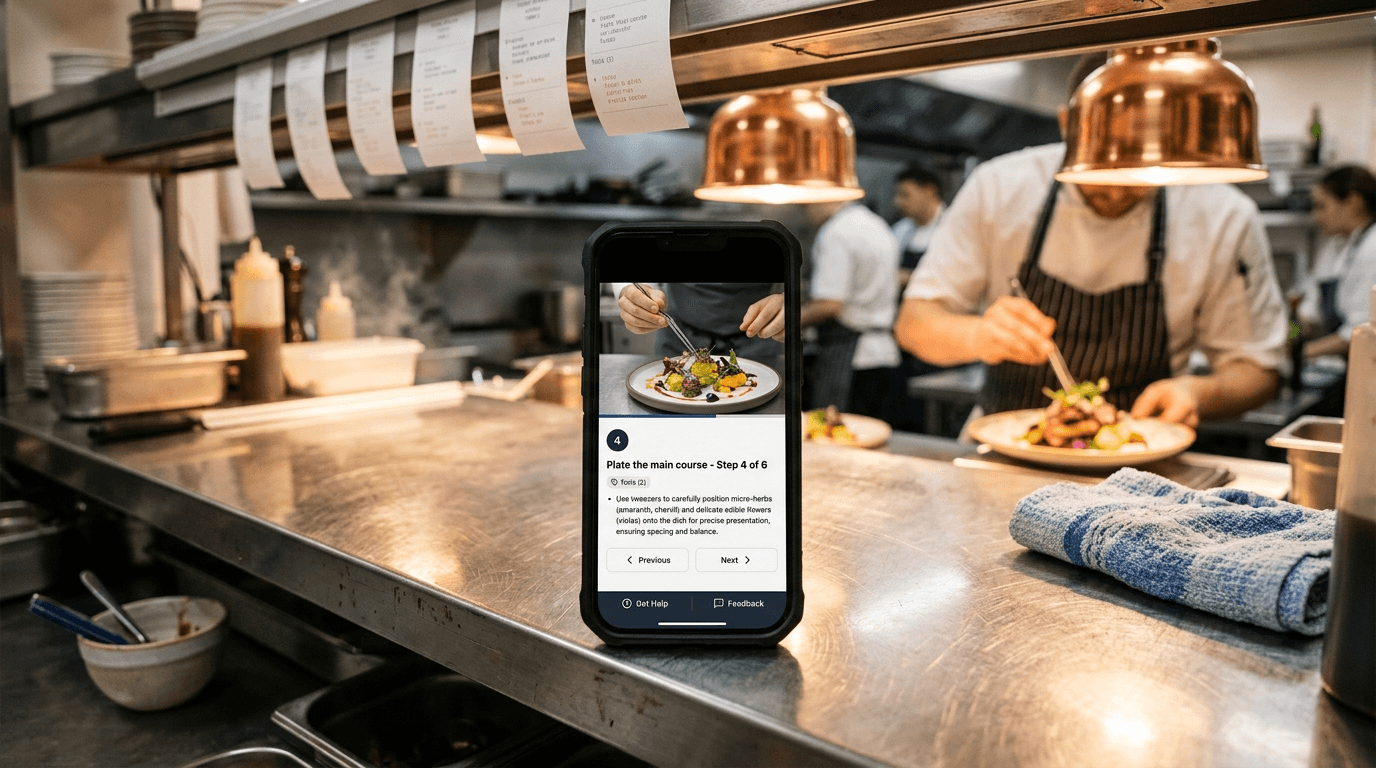
The shift that matters is from a training resource to a shift companion - something that stays open while the work is happening, as useful on shift fifteen as it was on shift one. Here's what that looks like in practice.
Your closer opens the closing checklist on their phone at the start of close. Each step is there, individually, with the video clip showing how it's done in your venue. They work through it, checking off each step as they go. It's tracking their progress through tonight's close, not whether they completed a training module three weeks ago. When they hit the till void step and can't remember which button resets it, they tap the step and see exactly what to do. If they need more help, there's a Get Help button on every step that connects them to an answer.
When someone has a question that could live anywhere across your guides - where's the stopcock, what temperature for the bain-marie, which gas pressure for the new kegs - they search for it in plain language and get an answer cited from your own training materials. The answer comes from something someone in your business filmed or documented, with a citation pointing to the exact step in the exact guide. It works in over 10 languages, which means your prep cook who speaks better Polish than English can ask the question in Polish and get an answer drawn from your English-language guides.
The checklist, the step-by-step navigation, the search, the cited answers - together they turn the training content you already built into something your team actually uses after week one. The guide doesn't retire once onboarding is over. It's there on every shift, for every task, as the thing people open when they need to get something right.
The close at 11pm
Think about your closer tonight. It's 11pm, the last customer has gone, and they're working through the close on their own. They've done it a few times now, they know the broad strokes, but they hit a step they're not sure about. Maybe the alarm sequence, maybe the till cash-up, maybe something that changed last week when you switched the process. They pull out their phone, tap the step, and see exactly what to do. They get it right, lock up, and go home. And so do you.
The training content you built was good. It just needed a longer shelf life.
If any of this sounded familiar, we built Lattify for exactly this problem.
Join the Waitlist