Your Training Tool Has a Shelf Life of About a Week
The tools built for onboarding collect dust once the new starter hits the floor. Here's what the floor actually needs.
Eamonn Best
Founder, Lattify · April 7, 2026
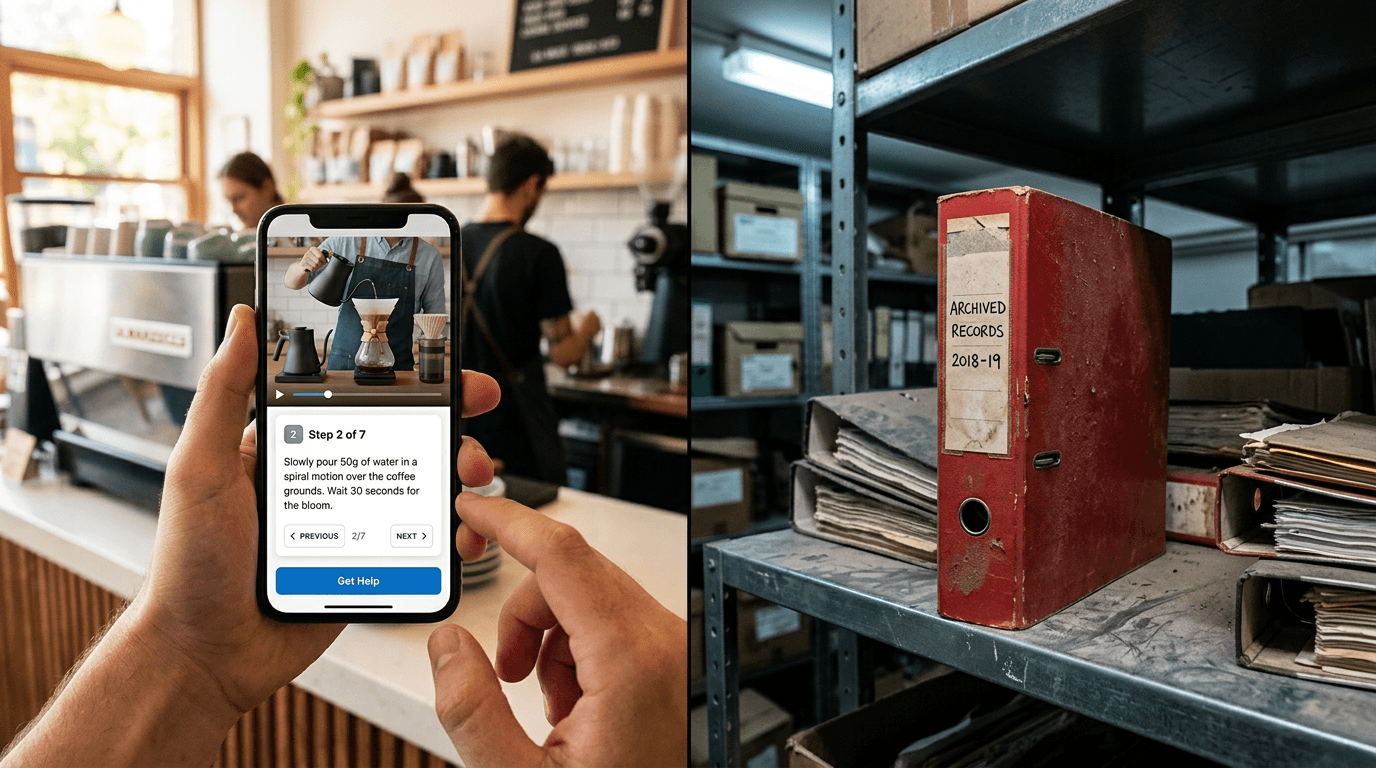
There's a moment every owner of a restaurant, a building site, or a hotel knows well. The new person finishes their first week. They've done the onboarding. They've watched the videos, ticked the boxes, maybe even passed a quiz. And then Monday comes around and they're standing at the pass, or the scaffold, or the front desk, and they have a question about something specific - how much beef goes into the ragu, which fire door stays locked after 9pm, where the stopcock is - and the onboarding material is somewhere they'll never open again.
The work is just starting, and the gap between finishing onboarding and actually performing on the floor is where most of the problems live.
The week-one cliff
I've spoken to dozens of small business owners over the past year, across hospitality, construction, trades, and property management. The pattern is remarkably consistent. Onboarding gets a burst of attention in the first few days, and then the new person is expected to just know things. The resources that helped them in week one - the manual, the training platform, the PDF in the shared drive - quietly become irrelevant because they were built for learning mode, and learning mode ended on Friday.
According to ATD research published in 2025, 75% of organisations use on-the-job coaching by managers as their primary method for training frontline employees. That's managers, on the floor, showing people how to do things in real time. The formal training system, whatever it is, has already faded into the background. The manager's time has become the training system, which means the manager's time is now permanently consumed by questions they've already answered a hundred times.
In 2018, Emergence Capital found that 80% of the global workforce - roughly 2.7 billion people - are deskless, and less than 1% of software venture funding was going toward building technology for them. That research is eight years old now. The workforce hasn't shrunk. A BCG survey of 7,000 deskless workers in 2022 found 37% were at risk of quitting within six months. The tools have improved since 2018, but the gap between what desk workers get and what everyone else gets is still enormous.
What happens on shift seven
Here's a specific example. A property manager I know, Carlos, manages post-closing handovers for new homeowners and runs multilingual construction crews across several sites. His challenge has nothing to do with onboarding. His people know how to do their jobs. The problem is consistency across sites, across languages, across the Tuesday afternoon when Carlos is at a different property and someone needs to check the gas isolation procedure before they can start work.
That's a shift-seven problem. A shift-twenty problem. A problem that recurs every time someone encounters a task they do occasionally rather than daily. And training tools, by design, don't help here because they were built for the arc of learning something new, then moving on.
The same thing happens in hospitality every single night. Your closer knows the close. But do they know what changed last Tuesday when you switched supplier and the new beer system needs a different gas pressure? The knowledge your team needs on shift is living, specific, and constantly updating. A training module captured in January is already stale by March.
Where the money is actually flowing
If you look at where investors are putting capital in frontline operations, the picture is telling. SafetyCulture, which started as an inspection app called iAuditor, now serves over 76,000 organisations and close to 2 million workers globally. They raised AU$165 million in September 2024. MaintainX, a frontline work order and procedures platform, raised $150 million in its Series D in July 2025, reaching a $2.5 billion valuation - more than double its valuation from eighteen months earlier.
These are operations tools. They live on the frontline worker's phone while they're doing the work. Checklists, procedures, inspections, work orders - things that happen on every shift, in real time. That's a fundamentally different category from tools that help you write up how a process works and assign it to someone during their first week.
The same ATD research found that 84% of organisations have not adopted AI-enabled training for their frontline employees, mostly because they lack staff with the knowledge to implement it. The operations world has sprinted ahead because the value proposition is immediate and daily: your worker opens the app, completes the checklist, the work gets done to standard.
The difference between learning and doing
Think about when you last used a recipe. If you're learning to cook something new, you read the whole thing, maybe watch a video, get your head around the method. That's training. But three weeks later, when you're making it again and you just need to check the oven temperature for step four, you don't re-read the recipe from the top. You need instant access to a specific piece of information in the middle of doing the thing.
Frontline workers have this exact need on every shift. The sous chef who needs the beef ratio for the ragu. The site worker who needs to confirm which PPE applies in the confined space. The hotel housekeeper who needs to check the turndown procedure for the suite that gets booked once a month. Each of them needs something specific, right now, while their hands are busy.
I've written about why Scribe and Trainual weren't built for this kind of business in detail. The short version is that those tools solve a genuine problem for desk-based teams who need to document software workflows and build knowledge bases. The gap - and it's an enormous one - is every business where the work happens in physical space and the worker needs help while they're doing it.
What the floor actually needs
This is what I built Lattify to do. Your best person films the task on their phone. Lattify's AI turns it into a step-by-step guide. That part handles the training side, and I've written about it before. But the piece that matters for this conversation is what happens after day one.
The guides stay open during work. They're live checklists your team works through on every shift, an operational tool used while doing the task. Your closer works through the closing checklist tonight. Your prep cook works through morning setup tomorrow. Each step is its own thing, accessible on their phone, right at the point they need it.
And when someone has a question that sits inside your training materials somewhere, they can ask. Ask Lattify is a conversational assistant that searches your organisation's own guides and returns a cited answer. Your sous chef types "what's the beef ratio for the ragu" and gets an answer pulled directly from the guide your head chef filmed, with a citation pointing to the exact step. It runs on Pinecone vector search with Claude Haiku 4.5 and the Citations API - the chunk search fires instantly on every query, and the language model engages selectively for questions and safety-related queries. Every answer traces back to a specific step in a specific guide that someone in your business created.
It works in over 10 languages, which matters when your construction crew speaks three different first languages and your training materials are in English. Carlos's crews can ask questions in Spanish and get answers drawn from English-language guides.
Why this category exists now
The technology to do this properly is genuinely new. Vector search that returns relevant results from a phone video transcript in under a second, language models that can cite their sources accurately, AI that can watch a raw phone video and break it into structured steps - none of that was production-ready two years ago. The reason frontline operations software is attracting billions in investment right now is that the underlying capabilities have crossed a threshold.
SafetyCulture started in 2012 as a checklist app and has spent a decade expanding into a full frontline operations platform. MaintainX launched in 2018 focused on work orders and has grown into procedures, messaging, and asset management. The category is maturing fast because the workers who use these tools use them every day, on every shift, which means retention is high and the value is obvious.
Lattify sits in this same space - daily execution, compliance, and knowledge access for deskless teams - with a specific focus on how the knowledge gets created in the first place. Pricing starts free for up to 3 staff and 5 guides, with paid plans at £49/month for 10 staff and £99/month for 25 staff across 3 locations.
The shift that matters
Eighty percent of the world's workers do their jobs with their hands, on their feet, away from a desk. The technology they've been given was mostly designed for the other twenty percent. That's starting to change, and the businesses figuring it out earliest will be the ones whose teams can find the answer to any question about how things work here, on their phone, in the middle of the shift when it actually matters.
If any of this sounded familiar, we built Lattify for exactly this problem.
Join the Waitlist