Scribe and Trainual Are Great. They Just Weren't Built for You.
The best training tools assume you have time to write. Most small businesses don't. Here's what actually works.
Eamonn Best
Founder, Lattify · April 1, 2026
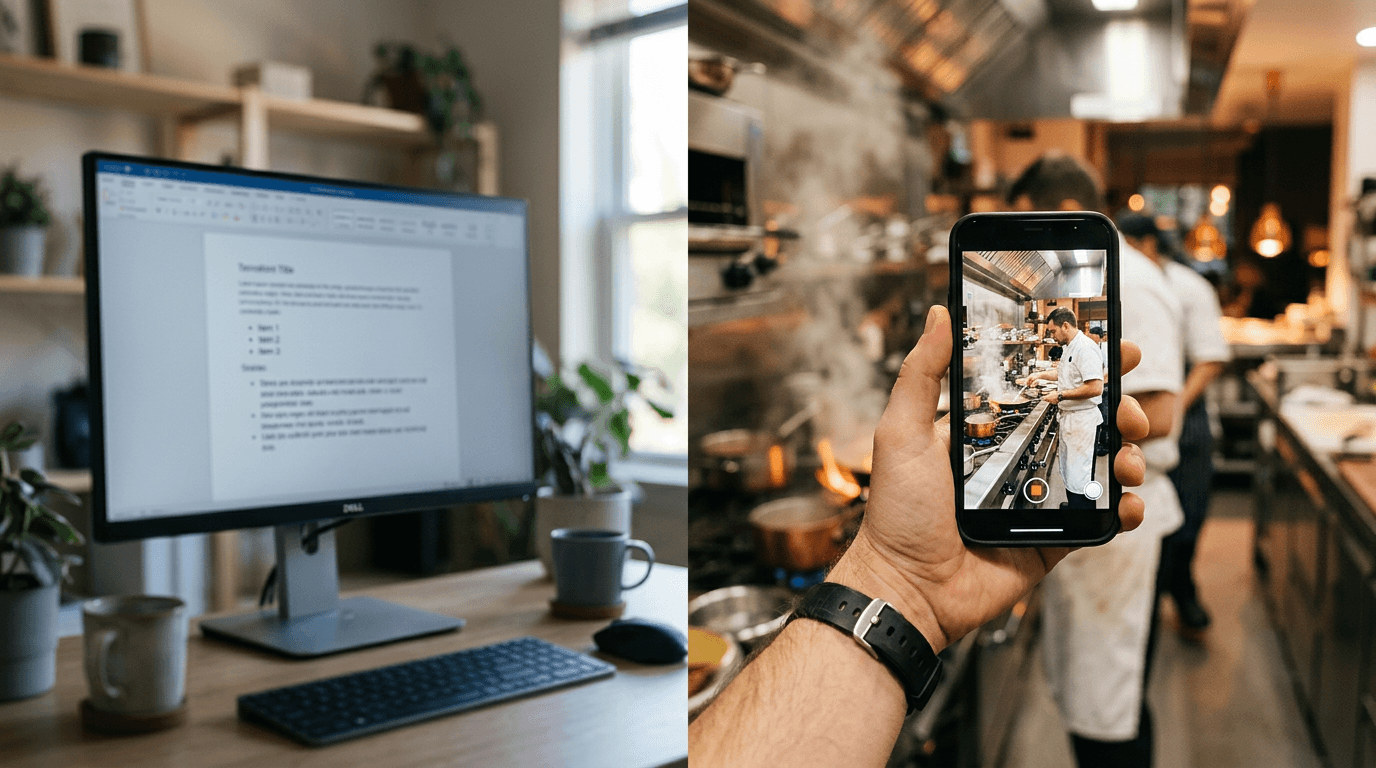
I searched "training software for small business" last year and Trainual was the first result. Their headline at the time was something like "Everything your team needs to know, all in one place." I remember thinking: yes. That is exactly what I want. That is exactly what every owner of a restaurant, a salon, a building site, a cafe with eight staff wants. All the stuff in your head, somewhere your team can actually get to it.
So I signed up. And within about twenty minutes I understood why most small businesses don't use it.
The writing problem
Trainual is a genuinely good product. Well designed, thoughtful, clearly built by people who understand how businesses run. The AI features are impressive. The role-based learning paths make sense. If you're an operations manager at a dental practice with forty staff and a morning free to document your processes, Trainual will serve you well.
Before any of that works, somebody has to sit down and write. You need to document your SOPs, type out your processes, build your training content. The AI can help structure it, but the raw knowledge still has to come out of someone's head and into a text box. For the kind of business Trainual targets - real estate offices, dental practices, business services - that's reasonable. Those businesses have people whose job involves sitting at a computer.
A restaurant owner working sixty-hour weeks, half of them on their feet, does not have a morning free to document processes. A construction foreman running three sites doesn't have time to type up how the scaffolding inspection works. The cafe owner with eight staff and no HR department isn't going to spend her Sunday evening writing onboarding docs in a software platform, no matter how clean the interface is.
The knowledge exists. The owner knows exactly how the close should work, how the prep should be done, how the keg lines get changed. The problem is getting it out of their head and into a format their team can use, and Trainual's answer to that problem is "write it down." For millions of small businesses, that answer doesn't land.
The screen problem
Scribe takes a different approach. Instead of asking you to write, it watches what you do on screen and automatically generates step-by-step guides from your clicks. It's clever technology, and for software-based workflows - how to process a refund in Salesforce, how to onboard a client in your CRM - it works brilliantly. There's a reason 78,000 enterprise customers use it.
But Scribe needs a screen to record. The tool captures browser activity and turns it into documentation. Which is perfect when the process you're trying to capture lives inside a piece of software.
Most of the knowledge in a restaurant, a trade business, a hotel, a warehouse, a gym lives in someone's hands. How to set up the pass for service. How to bleed a radiator on a combi boiler. How to fold napkins the way your venue does it. How to change the CO2 on the beer system. These are physical tasks performed by people in physical spaces, and no amount of screen recording captures them.
Scribe and Trainual both solve real problems. They solve the problems of businesses where knowledge lives in documents and on screens. The gap - and it's enormous - is every business where knowledge lives in people's heads and hands.
The gap nobody is serving
According to the UK Government's Business Population Estimates for 2024, there are 5.45 million small businesses in the UK, making up 99.2% of all private sector businesses. The vast majority of them have fewer than ten people. Most of them operate in the physical world - hospitality, construction, retail, trades, care, cleaning, logistics.
These businesses have the same fundamental need as any enterprise: get the knowledge out of the best person's head and into everyone else's. But the tools built to do that assume a level of time, infrastructure, and desk-based work that doesn't match how these businesses actually operate.
So what do they use instead? Nothing. A WhatsApp group. A laminated sheet behind the bar that was last updated in 2019. Shadowing, where the new person follows someone around for two shifts and picks up whatever they can. The gap between "enterprise knowledge management" and "nothing" is where most small businesses in this country have been living for years.
What actually works for physical businesses
The owner of a cafe with eight staff has one problem: capture what her best barista does and make it available to the next new starter. That's it.
The fastest way to do that is to film it. Her head chef films the morning prep on his phone - the mise en place, the labelling, the fridge rotation. Three minutes. Done. I've written about why video beats documentation for physical tasks in detail, but the short version is: when the task is physical, watching someone do it transfers knowledge faster than reading about it. And filming takes minutes where writing takes hours.
The problem with phone video on its own is that it's unstructured. A four-minute video sitting in a WhatsApp thread is barely better than nothing when your new closer needs to find step six at 11pm. Raw video captures the knowledge but doesn't make it usable.
That's the problem I built Lattify to solve. Your best person films the task once, on their phone. Lattify's AI watches the video and breaks it into individual steps - each one its own thing, each one searchable, each one accessible on the new starter's phone before their first shift. The owner doesn't write anything. The knowledge goes from the best person's head to a structured guide that the whole team can use, and the entire process takes less time than writing the first paragraph of a manual would.
The tool that should have existed already
Trainual has been around since 2018. Scribe since 2019. Both have raised tens of millions in funding, built excellent products, and solved genuine problems for their target customers. The reason neither of them built for restaurants, trades, and small physical businesses is straightforward: the technology to automatically structure a phone video into a usable training guide didn't exist until recently. You needed AI that could watch video, understand what's happening at each moment, and break it into steps. That capability is new.
Which means the owner of a twenty-seat restaurant and the foreman running a building crew have been waiting for a tool that could meet them where they actually are - on the floor, phone in hand, no time to write. That tool exists now.
If any of this sounded familiar, we built Lattify for exactly this problem.
Join the Waitlist